WINNER OF THE 2017 INDEPENDENT PUBLISHERS BOOK AWARD SILVER MEDAL IN POETRY

Softcover (ISBN: 978-1938235-26-9 )
$14.95
This debut poetry collection from Rona Jaffe Award winner Ashley M. Jones is an exploration of race, identity, and history through the eyes of a young, black woman from Alabama.
Release Date: 01/03/2017
Dimensions: 6 x 9 in.
80 pages
Magic City Gospel is a love song to Birmingham, the Magic City of the South. In traditional forms and free verse poems, 2015 Rona Jaffe Writer’s Award-winner Ashley M. Jones takes readers on a historical, geographical, cultural, and personal journey through her life and the life of her home state. From De Soto’s “discovery” of Alabama to George Wallace’s infamous stance in the schoolhouse door, to the murders of black men like Trayvon Martin and Eric Garner in modern America, Magic City Gospel weaves its story through time, weaving Jones’ personal history with the troubled, triumphant, and complicated history of Birmingham, and of Alabama at large. In Magic City Gospel’s pages, you’ll find that “gold is laced in Alabama’s teeth,” but you will also see the dark underbelly of a state and a city with a storied past, and a woman whose history is inextricably linked to that past.
Ashley Jones lays Alabama bare, wide, beautiful, terrifying and familiar in Magic City Gospel, this wonderful collection thick with where form, history, and even the wind are all rendered blackly and masterfully. Jones’ poems are alive with ghost and kin, God and Black girls, and all are sung, SANG really, under her capable hand. The red dirt is smeared all over this book, where we get to see Sammie Davis Jr. sing for Mike Brown & the Virgin Mary painted Black and Southern. Let Jones show you her land and her people, let me drive you across roads and time and show you what Alabama is about.—Danez Smith, Author of *[insert] boy*
In Magic City Gospel, Ashley Michelle Jones writes Birmingham, Alabama with the precision of one who grew up there. Seeped in the city’s difficult history, its food and folklore, this poetry explores the complicated racial and national identity of the author. In both free verse and received forms, these poems reverberate with heartache and humor. Ashley Michelle Jones’s voice speaks to her generation and beyond. She is an old soul in a young body—her work will serve as an important springboard for questions of race, gender, and social justice. Simply put, the United States needs MAGIC CITY GOSPEL. This is a stunning and important debut.—Denise Duhamel, author of *Blowout*
Ashley M. Jones’ Magic City Gospel is exact and exacting. Her intention is to name—and she does so in a way that renders into beauty all that is harsh about the American South. This is a poetry book that knows how to be a history book, a religious text, a book of redemption.—Jericho Brown, author of *The New Testament*
Order here!
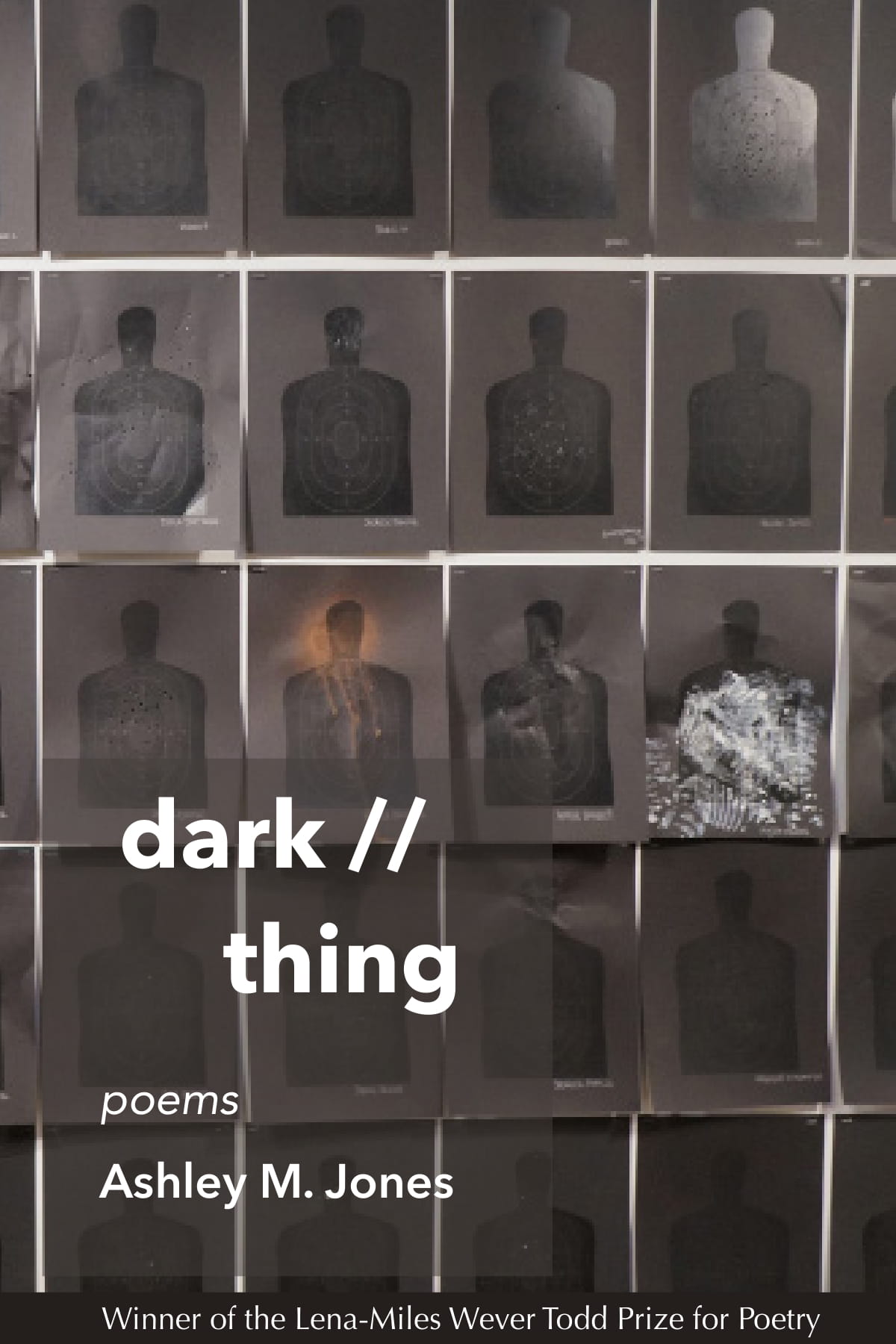
forthcoming February 2019 from Pleiades Press – winner of the 2018 Lena-Miles Wever Todd Prize for Poetry–
“dark // thing explores the operating costs incurred when blackness—black hair, black bottom, black diction and excellence—are perceived, but not uniquely seen. Ashley M. Jones has penned towns like Birmingham, Alabama and Flint, Michigan; penned America through the lens of Harriet Tubman, Dwayne Wayne, and the Emancipation Proclamation in a pitch tuned for everyone, whether you’re jonseing for sonnets, sestinas, or mathematical proofs. It is imperative that you read these poems, teach these poems, breathe deep this gift of a book.”
—Marcus Wicker, judge
“From “Song of My Muhammad:” “I know I have the best of time and space in my two black fists,” to “The book of Tubman:” “And God made a railroad out of dirt and sweat, made a train out of a woman, / And god made her hair a burning bush, / And God made her so holy even He called her Moses.” This delicate pavane surrounds us with notes that sing us home to our past and present. Sister Ashley’s words continue us on the holy meditation begun in the 1960s about what it means to be human, and I say amen. Awoman. Amen. Awoman. Amen. A womannnnnnnnnnnn.
—Sonia Sanchez, poet and activist

What is the price of a life, a stolen culture, a stolen heart? In formal and nontraditional poems, Reparations Now! asks for what is owed. Moving between voices and through intersecting histories, award-winning poet Ashley M. Jones offers perspectives both sharp and compassionate, exploring the difficulties of navigating our relationships with ourselves and others. From the murder of Mary Turner in 1918 to a case of infidelity to the oppressive nationalist movement of the present, Jones holds us accountable.
Praise for Reparations Now!
“In a book that is balancing history, trauma, rage, and joy as brilliantly as Reparations Now! is, there must be something beyond language that grips and holds a reader in place. For this, I am thankful for the generosity of this book, how the poems are shaped, how they challenge the eye as well as the ear, with rich payoffs at the end. I am thankful for the population of this book — how it bursts with ancestors and homages, places rendered so stunningly that they are present and touchable. What a massive undertaking, and what an achievement.” – Hanif Abdurraqib, author of A Fortune For Your Disaster
“Our present day, as well as the days at our backs, are stunned by their own particular sorrow. There is much lamentation to disorder the air. There are legions of hushed black bodies. There is that numbing loneliness, the taciturn breaking of hearts in the midst of chaos. But there is also, always, James Brown’s unearthly squeal, his miraculous camelwalk. There is a mother’s blaze-warm voice on the line from home. There is God in a father’s hands, in Mahalia’s reverent wail, in a sunlit home. Here in these pages of unerring witness, the poet reckons with a seemingly ceaseless grief while acknowledging the light that keeps us facing forward–the fact that being beautiful and black does not require a revolution.” -Patricia Smith, author of Incendiary Art, Finalist for the Pulitzer Prize
“Ashley M. Jones is a genius in how she wields, innovates, and wades through a bounty of poetic forms (sonnets, an aubade, a ghazal, a contrapuntal, anaphora, the subjunctive mode and so much more) with a sense of mastery, levity, and play. This collection is jam-packed with music, grace, and grit. I felt loved and seen by Reparations Now! The book is a personal mix CD in verse curated by Black bliss and brilliance. I kept dog-earring pages for prompts and poems I wanted to read again until I realized the whole collection was mangled by my enthusiastic appreciation and inspiration.” –Tiana Clark, author of I Can’t Talk About the Trees Without the Blood
What Things Cost
an anthology for the people
Edited by Rebecca Gayle Howell, Ashley M. Jones and Emily J. Jalloul
Published by: The University Press of Kentucky
Imprint: The University Press of Kentucky
Sales Date: 03/07/2023
352 Pages, 6.12 x 9.25 x 1.18 in
- Hardcover
- 9780813182438
- Published: 03/07/2023
$27.95 TDBUY
Other Retailers:
What Things Cost: an anthology for the people is the first major anthology of labor writing in nearly a century. Here, editors Rebecca Gayle Howell & Ashley M. Jones bring together more than one hundred contemporary writers singing out from the corners of the 99 Percent, each telling their own truth of today’s economy.
In his final days, Rev. Dr. Martin Luther King Jr. called for a “multiracial coalition of the working poor.” King hoped this coalition would become the next civil rights movement but he was assassinated before he could see it emerge as the Poor People’s Campaign, now led by Rev. Dr. William J. Barber II and Rev. Dr. Liz Theoharis. King’s last lesson—about the dangers of dividing working people—inspired the conversation gathered here by Jones and Howell.
Fifty-five years after the assassination of King, What Things Cost collects stories that are honest, provocative, and galvanizing, sharing the hidden costs of labor and laboring in the United States of America. Voices such as Sonia Sanchez, Faisal Mohyuddin, Natalie Diaz, Ocean Vuong, Silas House, Sonia Guiñansaca, Reginald Dwayne Betts, Victoria Chang, Crystal Wilkinson, Gerald Stern, and Jericho Brown weave together the living stories of the campaign’s broad swath of supporters, creating a literary tapestry that depicts the struggle and solidarity behind the work of building a more just America.
Lullaby for the Grieving
by: Ashley M. Jones
Release date: Sep 16th, 2025
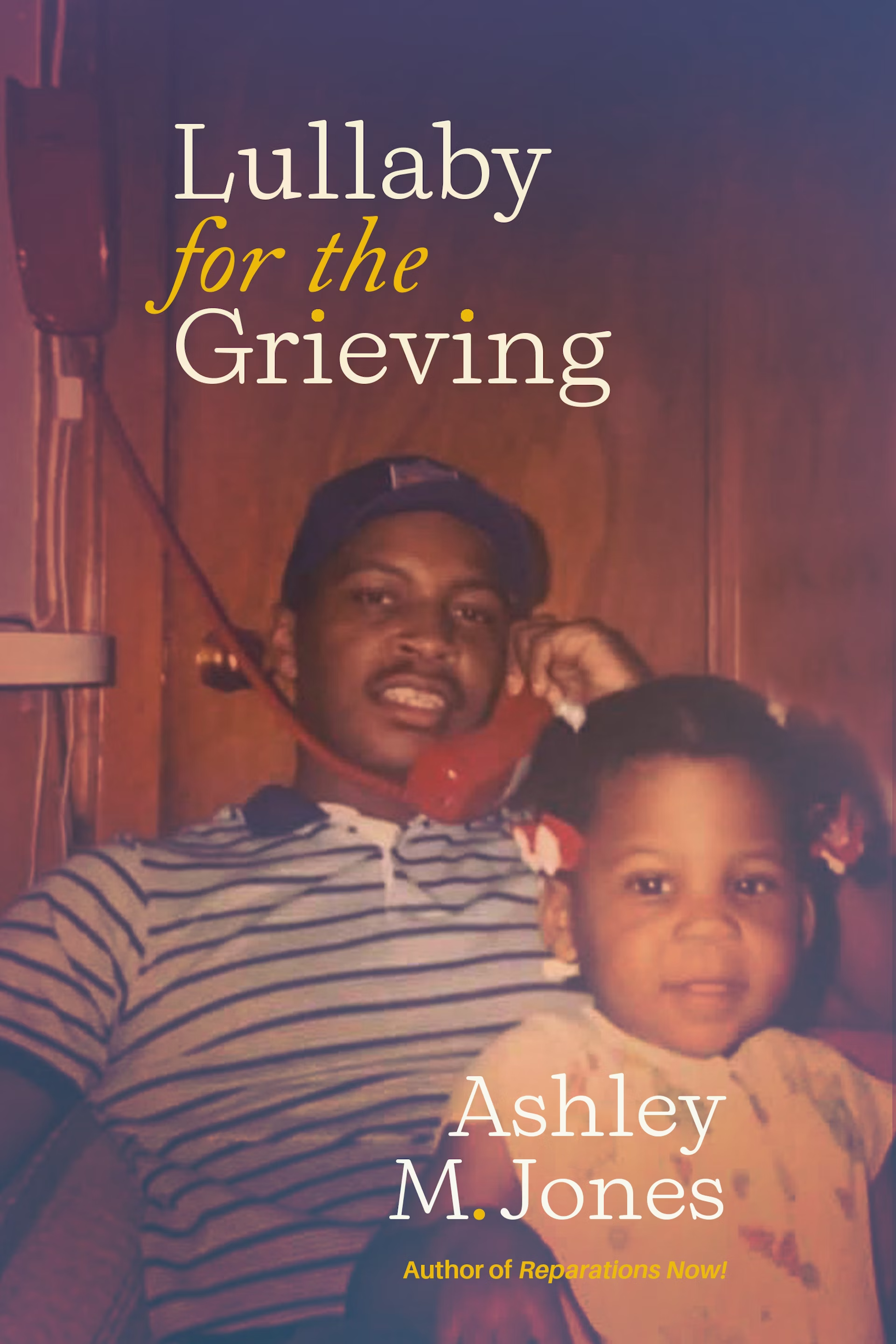
Lullaby for the Grieving is Hub City’s third poetry collection from PEN/Voelker-longlisted poet Ashley M. Jones. Read More
Softcover – $16.00
(ISBN: 979-8-88574-058-6)Add To Cart
Lullaby for the Grieving is Hub City’s third poetry collection from PEN/Voelker-longlisted poet Ashley M. Jones.
Lullaby for the Grieving finds the poet in the throes of profound grief in personal and political ways, but also in the throes of finding profound joy. In poems in traditional and received forms, Lullaby for the Grieving finds calm in unimaginable storms, and it attempts to listen for the sounds of healing therein.

What the Mirror Said
The Necessity of Black Women in Poetry
Subjects: Writing, Literary Studies, Poetry and Poetry Criticism, Essay and Interview
Series: Poets on Poetry
Imprint: University of Michigan Press
Paperback : 9780472040193, April 2026
Ebook : 9780472222568, April 2026
See expanded detail +
DOI: https://doi.org/10.3998/mpub.12396109
Pre-Order Paperback $16.95shopping_cart
Request Desk or Examination Copy | Request Media Review Copy
Recommend to Your Library | Request Accessible Copy
Finding the glow of possibility in poetry
Description
When did you feel the pull of poetry? For Ashley M. Jones, the moment she knew she would be a poet was at seven years old—reciting “Harriet Tubman” by Eloise Greenfield. That moment, that poem, showed her there was a place for her in the world of literature as her full Black self. As she continued to grow as a person and a poet, becoming the first person of color and the youngest person to serve as Poet Laureate of Alabama, Jones encountered so many incredible Black women poets who showed her the possibilities.
Part critical essay, part personal essay collection, What the Mirror Said traces the influence of nine Black women poets in Jones’s writing and life. She brings together historical biographical information, personal reflection, and close readings as she explores personal connections to poets from Phillis Wheatley to Patricia Smith. This book is expansive in its study, from classical metrical scansion to metaphorical explication. In offering new ways to interpret poems by important contemporary poets, What the Mirror Said makes the case for the need to study and celebrate Black women poets.
 Ashley M. Jones